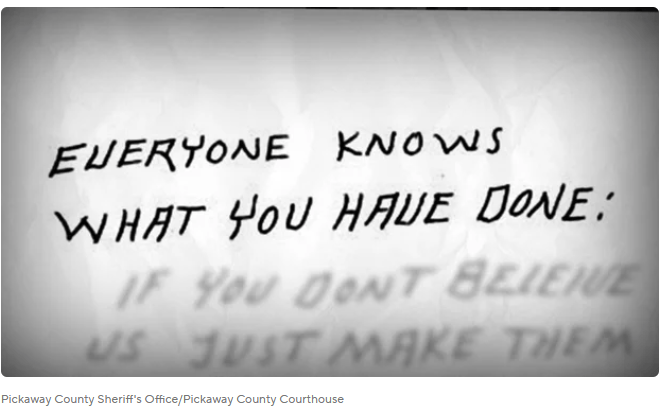
In the late 1970s, the quiet town of Circleville, Ohio, became the center of one of America’s strangest mysteries. Residents began receiving anonymous letters filled with accusations, threats, and claims of secret wrongdoings. The notes were written in block letters, mostly mailed from Columbus, and had an ominous tone, implying the writer knew personal details of people’s lives.
The first major target was school bus driver Mary Gillispie. The letters accused her of having an affair with the local school superintendent and warned her that she should stop the affair or they would expose her secret. Mary denied the accusations, but the letters continued to arrive. Soon, her husband, Ron Gillispie, began receiving letters as well.
Ron was furious and distressed by the harassment. In 1977, he received a phone call believed to be connected to the same anonymous writer. Afterward, he left his home in a hurry and died in a single-car crash. Authorities ruled his death an accident, even though his gun had fired once. Further, Ron did not drink, but his blood alcohol level was over the legal limit.
Several years later, the case escalated. In 1983, Mary discovered a vulgar sign about her daughter posted along her school bus route. When she attempted to remove it, she discovered a box containing a loaded gun set up as a booby trap. The weapon failed to fire, but the incident turned the anonymous harassment into an attempted murder case.
Police traced the gun to Mary’s former brother-in-law, Paul Freshour. Investigators believed he had a motive as a family member and the opportunity. Further, handwriting experts testified that the threatening letters matched his writing style. Freshour was later convicted of attempted murder. He maintained his innocence, insisting he had nothing to do with either the booby trap or the letters. Yet further investigation revealed that the gun belonged to Freshour, although he claimed he had lost it weeks before the incident.
The most unsettling twist came after Freshour’s conviction. Threatening letters continued for 20 years and ended after Paul’s release from jail in 1994. Throughout the 20 years, new messages continued to appear, some addressed to Freshour while in prison. These letters mocked him and claimed that the writer had “set him up.” The continued correspondence raised serious doubts about Freshour. How could the same person keep mailing letters while incarcerated, especially when the jail restricted access to writing materials?
This is where the case grows murkier and more psychologically complex.
One possibility is that Freshour somehow arranged for someone else to send the letters on his behalf. Another disturbing possibility is that the town had more than one “Circleville writer.”
However, once the pattern of anonymous accusations became known, it may have created a perfect cover for others to take part. Anyone with a grievance, a rumor, or a sense of moral outrage could imitate the block handwriting and hide behind the identity of the unknown author.
History shows that “poison pen” cases often evolve this way. What begins with one person can become a community phenomenon, in which multiple individuals use anonymity to expose secrets, settle scores, or enforce their own version of justice. The Circleville Letters targeted many unrelated people, making the theory of copycat writers plausible.
Today, the true authors of the Circleville Letters remain unknown. Ron Gillispie’s death, Paul Freshour’s conviction, and the long trail of anonymous mail left behind a haunting question: was this the work of one obsessed individual, or did an entire town contribute to the fear by using the letters as a mask for gossip and accusation?
Today in Circleville, people no longer wonder who wrote the letters, but how fast suspicion and gossip turned into weapons.


