Valentine’s Day has undoubtedly progressed throughout the years. The Day of Love encompasses first dates, marriage renewals, children’s crafts, and single people’s events. But who would have thought that Valentine’s Day would include a massacre of seven people?
The 1920s saw a severe increase in bootlegging with the Prohibition of the creation, sale, and import/export of liquor. George “Bugs” Moran and Al Capone had been vying for control of the lucrative Chicago bootlegging trade. Moran had taken over several of Capone’s saloons, insisting they were in his territory. That scheme created a deep animosity between the two mafia leaders.
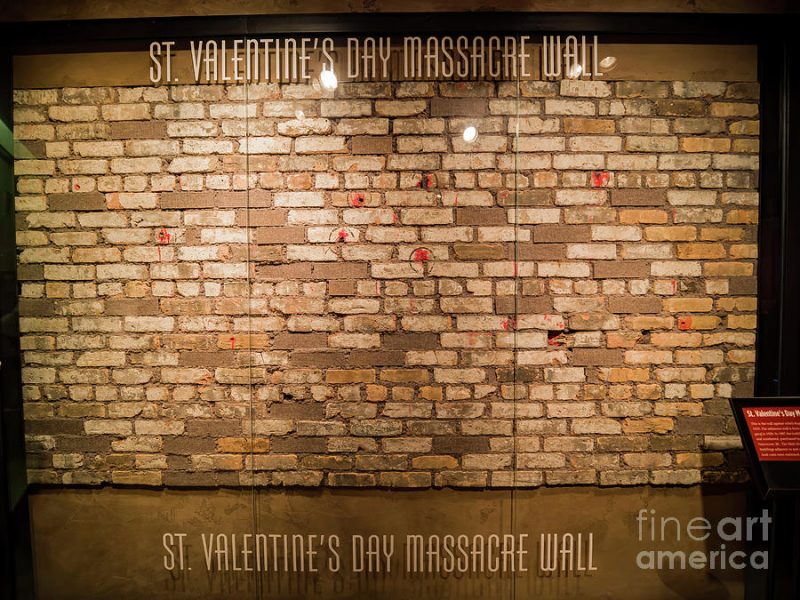
On the morning of February 14, 1929, the infamous Bugs Moran and seven men associated with the North Side gang called a meeting at the SMS Cartage warehouse in Chicago’s North Side, where the group often met. That morning, four men, two dressed as police officers, entered the garage. Believing it to be a routine police raid, the gang members complied when ordered to face the wall. What happened next was a ruthless and calculated execution carried out with Thompson submachine guns. The killers left without a trace, and no one was ever formally charged.
In a stroke of what some call “luck,” Moran was not there, leaving his Parkway Hotel apartment late. He and fellow gang member Ted Newberry were approaching the rear of the warehouse from a side street when they saw a police car near the building. They immediately turned and drove to a nearby coffee shop.
Most of the authorities theorized that Al Capone, leader of the South Side Gang, masterminded the plot to kill Bugs and his men to eliminate and weaken his hold on the lucrative bootlegging trade. However, Capone, conveniently in Florida then, denied any involvement.
But Capone was the easy scapegoat for the killings. Information about rouge police officers in street clothes and gangsters dressed in police uniforms led many to speculate that corrupt cops or gangsters impersonating law enforcement played a role. Witnesses in the alleyway reported seeing “officers” leading plain-clothes men away in what seemed like an arrest. Some theories suggest that police officers, bribed by Capone, may have been involved in some capacity, either by providing uniforms or arranging the raid. The level of organization required to pull off such a ruse suggests inside knowledge, possibly involving corrupt elements within law enforcement.
Another possibility is that a Moran insider, working with Capone or another rival group, enticed the men into the garage that morning under pretenses. The fact that Moran survived despite arriving late suggests he received a last-minute warning or was never part of the original plan. If a trusted member of the North Side Gang had played a role in orchestrating the massacre, the betrayal would explain how the killers managed to infiltrate the gang’s territory so quickly.
Yet, in an unexpected turn of events, one of Capone’s top gunmen, Jack McGurn, was assassinated in 1936—on Valentine’s Day, no less. McGurn avoided trial for the massacre due to insufficient evidence. Still, his death fueled speculation of a cover-up to suppress further information. Some suspect Capone’s organization’s methodical elimination of witnesses ensured the masterminds behind the massacre remained anonymous.
On February 25, 1957, at the age of 63, Moran died at Leavenworth Prison of lung cancer a few months into his 10-year sentence for robbery and conspiracy to transact counterfeit checks totaling $62,000.
In 1931, the authorities finally convicted Al Capone of tax evasion and sentenced him to eleven years. Capone showed signs of neurosyphilis early in his sentence and became increasingly debilitated before being released after almost eight years of incarceration. In 1947, he died of cardiac arrest after a stroke at the age of 48.
Despite the many theories, the St. Valentine’s Day Massacre remains unsolved. No concrete evidence can tie Capone, the police, Moran, or their associates to the crime.
Until our next mystery!
Harper

 HARPER GALE BOOKS